The lioness


The lioness, Zuri, was seen holding Nyack by the neck until he stopped moving. Photograph: Reuters

A lioness killed the father of her three cubs at the Indianapolis zoo, suffocating her longtime mate by locking her jaws on his neck.

Zoo officials were at a loss to explain the attack by Zuri, a 12-year-old female African lion, on her 10-year-old mate, Nyack.

The lions had been held together for eight years and had three cubs in 2015, the zoo said in a statement. Zookeepers had never before noticed any aggression between the pair.

Staff rushed to the lions’ enclosure after hearing an “unusual amount of roaring” and found Zuri in a fierce fight with the father of her cubs.

“She had Nyack by the neck,” said the zoo’s curator David Hagan. “Keepers came up and saw what was occurring and made an attempt to separate the two. But she continued to hang on to Nyack by the neck until he stopped moving.”

Zoo staff were devastated by the death and may never fully understand what happened, Hagan said. “They build strong bonds with the animals so any loss affects us all greatly. 

An autopsy found Nyack died of suffocation from injuries to the neck. One of the couple’s offspring, a three-year-old female named Sukari, was in the outdoor lion pen at the time and was not hurt.

Nyack and Zuri’s two male cubs are kept in a separate part of the exhibit, having been separated earlier this year at the age when male lions reach young adulthood and typically leave the pride.

“We will conduct a thorough review to attempt to understand what may have led to this,” the zoo wrote on its Facebook page. “Zuri and the other three lions are all OK. Nyack was a magnificent lion and he will be greatly missed. We appreciate the support from our community as we cope with the loss.”

The lioness was on loan from San Diego zoo as part of the species survival plan managed by the Association of Zoos and Aquariums. There were no immediate plans to change how the lions are managed, the zoo said.

The zoo described Zuri on its website as an “attentive and protective mother”, usually found “keeping an eye on her three cubs”. She weighs about 325lbs, 25lbs less than her mate.

Nyack was described as a “very vocal and laid-back” lion with a large mane, a fan of spices and playing with boomer balls. “He can often be heard roaring on exhibit,” the zoo wrote.


Gallery:
Watch out, Drongos: competitive birders gear up for 30-hour challenge


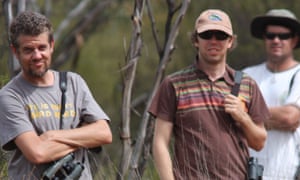
Mick Roderick, left, and his Hunter Home Brewer teammates are competing in 30-hour birding challenge this weekend Photograph: Supplied

Mick Roderick is a five-time bird-spotting king, serial champion and former record holder. This week, he is ready to get back on top. In his sights are a team called the Dodgy Drongos, who have dominated the competition in recent years.

His sport of choice is the Twitchathon, a 30-hour cross-country birding challenge organised by conservation body BirdLife Australia as part of national bird week.

His team, the Hunter Home Brewers, plan on travelling 1,100km, from the mountains of the Great Dividing Range to the New South Wales coast.

“If you want to be competitive in New South Wales, you need to start west of the Great Dividing Range,” he says. “Getting the maximum number of species is about covering the most kinds of habitats. You need to get some of those inland birds.”

The intensive Twitchathon is only one of the bird-spotting challenges taking place this week.

On Monday, the celebrations began with the launch of the Aussie Backyard Bird Count – a more accessible project that brings ordinary bird enthusiasts together to sit down and get counting.

Some 70,000 Australians are expected to spot more than 2 million birds in the week-long count, now in its fifth year.

Participants spend 20 minutes in a backyard, local park or outdoor space, noting bird species, numbers, size and colour and entering the data on an app or online.


For the more hardcore, the weekend offers the thrill of competition. As well as the 30-hour challenge (known as “the big weekend”), BirdLife also runs a 12-hour and three-hour version.

BirdLife Australia’s Sean Dooley says the 70,000-person count plays a crucial role in conservation – enlisting enthusiastic citizens to help researchers.

“Australia is a vast country, we’ve got a small population and a ridiculously small research budget from various governments,” he says.

“There are still huge gaps in our knowledge about our bird populations. This count is our way to gather information about overlooked birds – everyday Australians become our reporters in the field.”

Data from BirdLife’s previous counts revealed a potential decline in kookaburra populations in urban areas. Backyard watchers have also noticed a rise in raptors (wedge-tailed eagles, powerful owls and other birds of prey) in urban areas – which they believe is the impact of drought.

Dooley is hopeful this year’s backyard count will break last year’s record. By Monday afternoon, birdwatchers had already submitted 9,800 checklists and sighted 314,000 birds.


Meanwhile competitors like Roderick have planned their routes for months, taken the measure of their opponents, researched recent sightings and already set out to scout their locations.

“The Dodgy Drongos, they have been dominating in the last few years. They set a new benchmark, scoring 264 different bird species in the 30 hours. Our team hold the record for the old 24-hour competition. We’ve won it five times and last year was the first time in 17 years we didn’t get a place, so we’re quite sore about that.”

This year, 19 teams are registered for the national 30-hour event, 37 teams for the 12-hour version, and 23 for the three-hour race.

“The Twitchathon raises a substantial amount of funding for state-based local bird conservation projects,” says Dooley. “It has kept things like the powerful owl project going in Sydney, which has now expanded to Melbourne.”

Roderick can’t wait.

“There is a special bird this year, called an Aleutian tern,” he says. “It is a very newly discovered species for Australia. The last two years in a row, the terns have arrived at a place called Old Bar on the NSW north coast. It’s kind of a new bird for Australia.

“We look forward to the Twitchathon every year. The following day after a Twitchathon you’re thinking about next year’s Twitchathon.”

Gallery:


Country diary: seals' woeful cries cut through the noise of the wind


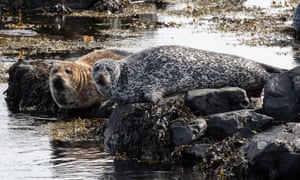
Seals drape themselves over rocks on Rathlin Island. Photograph: Courtesy of Philip Hartwell


On the map, Rathlin lies on the sea like a discarded boot. (If Italy is high-heeled and elegant, this version has a battered, medieval look.) The sea here is the Sea of Moyle, where, according to Irish mythology, the Children of Lir were banished for 300 years after being turned into swans by their stepmother.

The ferry from Ballycastle has delivered us to Church Bay, the inner angle of the island. The wind is strong, bright sunlight alternates with showers, mackerel clouds stream overhead. We have six hours. An elderly bus waiting at the harbour makes up our minds about where to go first; it bounces us along a winding road, past fuchsia hedges and scattered farms, to the RSPB centre at Bull Point. Here, at the top of the boot, viewing platforms overlook precipitous cliffs and fulmars hang in the air, almost within touching distance. Westwards: 

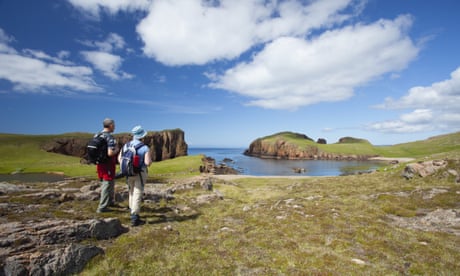
Delivered back to Church Bay, we set off on foot for Rue Point, the toe of the boot. The road dips and climbs, edged by windswept grassy banks still showing the odd harebell, scabious and tormentil, stragglers from late summer. Everywhere are sparkling glimpses of sea. The cottages peter out and the loughs begin, glinting with ruffled water or tightly packed with reeds. Black cattle graze between rocks and gorse, meadow pipits dart and call. It has begun to rain, but we sit on a wall to eat our sandwiches anyway.


The sun reappears as the road dwindles and disappears into a low, narrow headland at Ushet. We walk down to a ruin, waves slapping the shore on either side, and sense we are being watched. Across an inlet are two seals draped over rocks, heads raised. Picking our way past, we spot three more, silver, brown and blotchy cream, and suddenly realise there are dozens, all around. Mostly they ignore us, though occasionally one takes offence, heaves itself off its sunbed and flops into the water. From time to time their woeful sounds cut through the noise of wind and sea.

Legend has it that after ferocious storms the Children of Lir were reunited at Seal Rock on Rathlin. Might it have been here?

Gallery:

Trick or treat: should you dress up your dog for Halloween?

US dog owners spend $350m a year on elaborate costumes for their pets, and the trend is spreading to Britain. Is it harmless fun – or animal cruelty?


Halloween has become big business over the past two decades. In 2001, the British public spent £12m a year on it; that annual figure has since ballooned to £330m. There has also been a huge increase in spending on costumes for our pets, with more and more high-street stores, including Marks & Spencer and H&M, stocking them. There are fuzzy pumpkin, Darth Vader and Beetlejuice costumes available at Pets at Home this year, a ghost costume from Lidl and the inevitable unicorn from B&M. Rubie’s, which claims to be “the world’s largest designer, manufacturer and distributor of fancy dress costumes”, has a range of more than 50 costumes for dogs, including the chance to dress up your pet as Scooby 

In the US, dog owners are estimated to spend $350m each year dressing them up. The Tompkins Square Halloween dog parade in New York is about to enjoy its 28th year, and features hundreds of dogs in elaborate costumes with props. It is one of the few places on Earth where you can see dogs dressed up as wizarding students riding the Hogwarts Express, a dog driving the time-travelling DeLorean from Back to the Future, pooches lining up as the famously flamboyant rock band Kiss or, thanks to a couple of prosthetics, appearing as the three-headed dog Cerberus.

This trend is partly a result of the Instagram age; on social media, videos of costumed pets are a genre in their own right. Compilation videos of dogs in costumes can rack up millions of YouTube views, and there are nearly 200,000 posts on Instagram with the hashtag #dogcostume. Social media users have gone wild for Chrissy Teigen’s French bulldog dressed as bacon, Ariana Grande’s shiba inu puppy dressed as a dinosaur and Miley Cyrus dressing her whole canine entourage as a banana split, a hamburger, a hot dog and a UFO.
FacebookTwitterPinterest A hotdog in the 2012 parade. Photograph: Dan Callister/Rex

But the trend hasn’t met with universal approval. Over the weekend, Chloe Jackson, a training manager at Battersea Dogs & Cats Home in London, questioned it, pointing out: “Not every dog is comfortable with a lot of handling and some will become very stressed if you try to put them in a costume – particularly if it involves forcing their legs into sleeves or putting something on their head.”

Linda Ward, who runs the Busters Dog Walking service in Brentwood, Essex, says that, while she would never put her own dogs in fancy dress, she doesn’t see it as a major issue. “Many dogs wear coats in winter, and assistance dogs wear jackets all the time they are working. Lots of dogs don’t even like collars or harnesses being put on, yet that is deemed acceptable.” From a dog’s point of view, a simple costume won’t feel very different. At the more extreme end of the trend, animal welfare activists have questioned the use of creative grooming at Halloween, with dogs having their hair cut, styled and dyed into unusual designs – there is a risk that animals may have allergic reactions to the products.

Cesar Millan, whose Dog Whisperer TV show has been broadcast in more than 80 countries, has advised owners to adhere to certain rules around Halloween costumes. While boots and coats can offer protection from the weather, elaborate costumes don’t. He has urged owners to remember that the costumes are for our enjoyment, not the enjoyment of the animal. “They can be very cute, and get a lot of attention,” he said, “but underneath the costumes, they’re still just dogs.”

Louise Glazebrook is a dog behaviourist and trainer who runs the Darling Dog Company in London. She says she doesn’t have an issue with dogs in costumes, but there are certain things to bear in mind. “Anything a dog wears shouldn’t inhibit natural behaviour; a dog should always be allowed to be a dog. A costume with a hood will cause stress and therefore change the dog’s behaviour and should be avoided. The other thing is to watch out for the material – a dog is going to get really hot in polyester or nylon.”

She says every dog is different, and the needs of, say, an Italian greyhound that needs layers in the winter are not the same as those of a bernese mountain dog with its thick natural coat. “Your dog will also tell you if it is unhappy,” she adds. “If their body language says they are unhappy or they seem stressed, just forget the costume altogether.”
Advertisement

Most owners would easily recognise if a costume was causing their dog distress, although Ward cautions that they may miss more subtle signs of stress, such as a dog licking its lips or initially refusing to move after the costume has been put on. But, as she reminds us, in the long list of cruel things humans do to dogs, “dressing them up as a pumpkin once a year doesn’t come close”.

Gallery:


Vietnam’s first ethical elephant tours launch


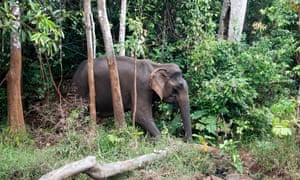
Model behaviour … the new scheme will let tourists observe elephants in their natural habitat. Photograph: Alamy

Amid growing global condemnation of elephant riding as a tourist activity, Yok Don national park in southern Vietnam has ended the practice and replaced it with the first ethical elephant experience of its kind in the country.

The formally captive group of four elephants were released from their chains earlier this month and no longer carry tourists on rides through the park. Visitors can instead observe the animals roaming freely in their natural habitat.

Previously, the Yok Don elephants, like many around the country, were chained up for extended periods of time, often without access to water. They were harnessed with heavy riding baskets, sometimes carrying tourists around the park for nine hours a day.

The largest of Vietnam’s nature reserves, Yok Don is in southern Vietnam near the Cambodian border, and is home to other wildlife, including leopards, red wolves, muntjac deer, monkeys and snakes.

The park worked on the initiative with Animals Asia, which campaigns for long-term changes in animal welfare and tourism in China and Vietnam. The official agreement between the charity and the state-run park was signed on 13 July, and runs until April 2023, with the first tours taking place earlier this month. Over the next five years, it is hoped that the new model will provide as much or even more revenue for owners as riding, and encourage mahouts and elephant tourism companies to follow suit.

“This project has entirely changed the lives of the elephants at the park and it is also provides a much better experience for the tourists. Exploitation has been replaced with respect, and if successful it’s a model we could see spread across the country,” said Dionne Slagter, Animals Asia’s animal welfare manager. “They all look so much healthier and are increasingly confident in how far they roam.”

The group of retired elephants includes three females, Bun Kham, Y’Khun and H’Non, and one bull, Thong Ngan. The elephants are also now able to form bonds with one another, and are beginning to the display the naturally complex social and emotional behaviour that herds 

To help with the transition, UK charity Olsen Animal Trust provided funding to to cover any initial losses, allowing the park to continue employing mahouts and guides to help ensure safety.

Awareness of the negative effects of elephant riding has increased in recent years, with a growing number of tourists avoiding cruel attractions and supporting welfare centres and genuine sanctuaries instead, alongside an increasing number of tour operators refusing to sell elephant treks that include riding.

Many of the elephants used in riding and other activities, such as painting or performing tricks, will have been caught from the wild as babies, their mothers often killed. Once captured, they often undergo intensive conditioning known as “crushing the spirit”, where they are kept in tiny pens and beaten and starved, sometimes for weeks.

In Vietnam, the number of elephants in the wild is estimated to be as low as 65 to 95, which conservationists say is not viable for survival. Numbers have declined dramatically over the past few decades, from an estimated 2,000 in the 1980s. Vietnam’s elephant riding industry also made headlines in 2015, when several animals died from exhaustion. Campaigners and charities hope to continue to educate the industry around the world, and show how profitable ethical elephant experiences, with retired and rescued animals, can be instead.

Responsible Travel has said it will consider adding the new Yok Don tour to their list of ethical elephant experiences – this would be the first in Vietnam to be included.

Gallery:


Specieswatch: how woodlice are an early warning system for a damp problem


There are 35 species of woodlouse native to Britain, including the common rough woodlouse. Photograph: Alamy Stock Photo

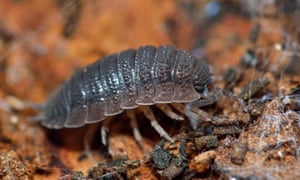
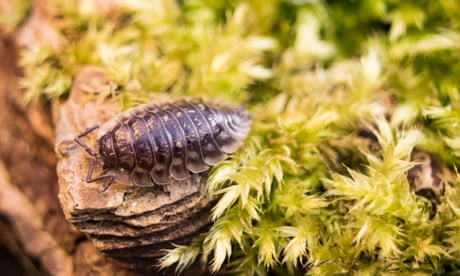
The common rough woodlouse Porcellio scaber is one of the five most numerous of 35 species of woodlice that are native to Britain, although there are others that arrived with imported plants and live mostly in greenhouses. Woodlice are remarkable in that they are not insects but crustaceans with 14 legs and an outer shell – their closest relatives being shrimps and lobsters. While they have adapted to life on land, they still need damp conditions to thrive and, like their aquatic cousins, use gills to breathe. If they appear in houses and survive it means there is a damp problem.


Woodlice are harmless and useful creatures in that they eat only decaying vegetable matter and, like worms, are one of nature’s great recyclers. They are helpful in compost heaps and as soil improvers, preferring to live in dark, damp places, often in large colonies. Although some species roll themselves into a ball using their outer casing as a defence against predators including birds, toads and spiders, the rough woodlice plays dead until the threat has passed. Researchers claim individuals have personalities with bold woodlice running off quite quickly and shy ones remaining immobile for longer. Some enthusiasts even suggest they are good to eat, tasting like shrimps – a useful tip if times get hard.


Gallery:


What is African swine fever and how does it spread?


Wild boar are one of the transmission vectors for ASF. In August scientists and government officials (seen here) workshopped a hypothetical outbreak in Germany. Photograph: Carsten Rehder/Alamy Live News

What is African swine fever?

ASF is a highly contagious viral pig disease. The most common symptoms of the virus in its acute form are a high temperature and loss of appetite; other symptoms include vomiting, diarrhoea, and difficulty with breathing and standing. There is no treatment for the disease, some versions can have a 100% mortality rate in certain circumstances. It is not the same as swine flu.

How does it spread?

ASF can be transmitted through direct contact with infected animals. Wild boar have been identified by some national governments as one of several possible culprits for the recent spread. It can also spread via insects such as ticks.

But the virus can also survive several months in processed meat, and several years in frozen carcasses, so meat products are a particular concern for cross-border transmission. It is believed that the disease was initially brought from east Africa to Georgia by contaminated pig products. Last week, a packet of sausages confiscated at a Japanese airport from a traveller arriving from China were found to contain the virus. Similar discoveries have been made in South Korea, according to reports.

What happens when it is found?

Cases must be reported to the authorities. In most countries, this will trigger quarantine measures and a cull of the affected herd. However, there is anxiety among experts that in some cases farmers – or even whole countries – may cover up or delay reporting the illness. In May, for example, Belarus was accused of covering up ASF among its pigs. The Belarus government denied the claims.

Can it be caught by humans?

Humans cannot contract ASF. However the head of the Russianepidemiology service, chief state sanitary doctor Gennady Onishchenko, has warned that pig physiology is close to human physiology, and that future mutations of the virus may therefore become dangerous to human beings too.

Why are people worrying about it now?

For many years ASF was found mainly in Africa, although there was an outbreak in Europe in the 1950s which took several decades to eradicate. In 2007, however, the virus was detected in Georgia, and despite co-ordinated efforts it has since spread widely, initially through eastern Europe and Russia, and more recently into western Europe, when wild boar in Belgiumwere found to have the disease. The virus has now jumped to China, home to half the world’s domestic pigs, and appears to be proliferating rapidly. According to one report there have been 41 outbreaks since the first notification in early August.

The UK government is monitoring the situation. Zoe Davies, head of the National Pig Association, has said that it may take years for ASF to reach the UK but points out that big jumps are possible. Earlier this year, she said: “I’ve had sleepless nights after seeing Polish lorry drivers barbecuing their supper in a layby. Pigs will eat anything – and in this country around 40% are reared outside. If those drivers had thrown their leftovers over the hedge, the consequences could have been disastrous.”

There is great concern in the US, too, where the pig export market is worth $6.5bn (£5bn) annually. Biosecurity measures are being stepped up and US government officials are drawing up a rapid response plan.

What other countries are concerned?

National governments around the world are now ramping up precautions in order to protect their domestic pig industries. Denmark has been planning to build a wall to keep out boar for some time now, and France is now also making plans for a wall along parts of the Belgian border. Germany has relaxed laws on wild boar hunting as part of its plans to prevent the disease breaking out.

Are there any vaccines or cures on the horizon?

The Roslin Institute is looking at gene editing to make pigs resistant to ASF. An international coalition of scientists is urgently investigating vaccines.

What is the long-term outlook?

The pig industry is certainly extremely anxious about ASF. If it is detected in another major pork-producing country like Denmark, Germany, Spain or the US, “the pig mortality will be the least of our worries”, according to US expert Dennis DiPietre. “The business disruption and profit losses from export cessation would range from big to staggering,” he says. DiPietre fears that, within a year or two, “we will be engulfed in a worldwide pandemic”.


Gallery: